Posts

Showing posts with the label business

Staking My Claim to MicroSnaking

Image
Project management processes often show the project progression by moving between the project team to do the work and a meeting with management to allow the project to move on to the next step. One expression for this sinuous depiction is "snaking." You can see the resemblance to a snake in the graphic. This type of process management is typical in Waterfall or Phase Gate processes.  Agile processes have become more common in recent years. They describe an iterative process with rapid testing, feedback, and turnaround. It actually looks quite similar, but rather than taking a few months, it takes a few weeks. Rather than going high on the chain of command, it goes up a level or two. Sometimes there are not phase gates at all, just continuous up and down. This up and down feedback, I am calling "MicroSnaking" or "micro-snaking." I'm the first. I stake my claim. The term is free for all to use. Knock yourself out.
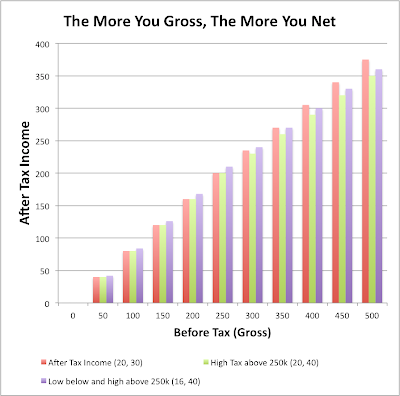
What They Mean When They Talk About Tax Hikes On The Rich

Image
Increase Taxes On The Rich - What that means There is a tremendous amount of innumeracy in this country. I don't know why that is. One thing I keep seeing is talk of tax hikes on those making more that $250k. I want to describe what that means. First, technically, it is an increase of tax rate on incremental (marginal) income above $250k. It's not simply raising the rates on everyone making more than $250k. It may have that effect, but the distinction is important. What is the distinction? Consider a person who makes $1.01 less than $250k. He or she will pay let's say $50k in income tax. If he makes $1 more, he will pay about $0.30 more taxes at a 30% income tax rate. Now let's say that the tax laws change so that income above $250k is taxed at 40% (up from 30%). It does not mean that suddenly his entire income is multiplied by 40%, it means that only the amount above $250k will be multiplied by 40%. So let's say our $249,999 earner gets a raise to $...

Settled Science, Republicans and Democrats

Ezra Klein recently published a blog post in response to a NY Times piece by David Brooks, the conservative on staff there. It was called "T he sad history of climate policy, according to David Brooks." It's interesting on some levels. It shows that the Republicans used their influence to kill initiatives to reduce carbon footprint, forcing the Democrats, who really wanted to do something about carbon into the corner of funding green startups as the only remaining available option. When some of those startups inevitably failed, the Ds became the bad guys on many levels. It is a sad story of the conversion of a bipartisan consensus going away for political gain. Klein makes the point that it is really quite clear who the bad guys are, the Rs. But there is a big assumption behind all this:  Catastrophic  global warming is happening. All the scientists say so. I sent this response to his column: "First, I completely agree with the premise that if Obama is for it, th...

Pre-read for Portfolio and Monte Carlo Lecture

Dear Saint Mary's Professional MBA students, I am looking forward to meeting you in class. Here is a brief description of my background. I am Manager of Portfolio and Planning for Chevron Corporate Business Development. I have a BSc in Geophysical Engineering from Colorado School of Mines. I did exploration work for many years, but found myself attracted to the business side. I received an MBA from the University of St. Thomas in 1999, effectively completing a long gradual shift from the technical to the commercial and financial side of the business. In the late 1990s, I built the cash flow model that we used in our new country entry into Brazil. I transferred to San Ramon in 2001, and since then, have been an advocate of portfolio methods and improved planning and decision methods at Chevron. My current position is responsible for ensuring that asset and corporate acquisitions will be a good fit with our corporate strategies. Overview Monte Carlo and Portfolio Management...

Long Term and Short Term

The following article appeared in Business Week magazine recently. I tried to write to them, but their website did not work for me. Here's the link to the original article. Here's the text. THE PSYCHOLOGY OF SAVING MORE (It was called "Short-term Thinking May Be A Saver's Best Friend" in the print version) Financial planners often suggest clients figure out how much they'll need to retire and save toward that huge number. Utpal "Paul" Dholakia, associate professor of management at Houston's Rice University, thinks people would do better to think about how much they'll save next month. A paper he co-wrote with Leona Tam of Old Dominion University found that those who planned savings for the next month did far better than those who tried to plan further out. In one experiment, people said they'd save an average $287 next month but saved $440. When asked to plan ahead four months, they said they'd save an average $946, but put aside jus...

Inbox Zero

Merlin Mann of 43Folders fame has a philosophy called Inbox zero. He gave this talk at the Google campus in July 2007. It's worth a listen, but if you don't have time, his advice boils down to dealing with your inbox everyday. Every mail gets one of 5 things done to it: Delete (or Archive) - Don't spend a lot of time on building archive folders. Use built-in search capabilities to find things Delegate (Forward to someone else) Respond (keep it short) - Appropriate response length is good. My comment is to put important content into the subject. Defer (Put into a pending folder) - something that you check periodically to see if it has resolved. I use flags in Outlook to keep track of my deferred actions Do or capture a placeholder for it (such as a calendar or a task) General principles: Do email less (unless of course your job is real-time) Do email on a schedule. Turn off mail arrival signals, then once per hour process it using the above five actions. Go back to work. Fi...

Plans, Goals, Forecasts, and Estimates

This entry on the Overcoming Bias blog got me thinking. Bosses just want the number . I see a lot of confusion between planning, estimating, goal-setting, and forecasting. Forecasting Forecasting as often used in business is simply giving someone the number that represents business performance. Forecasting accurately is impossible , except maybe in the very short or very long term. Nonetheless, you still at some point need to come up with a number. Forecasting is best done using probabilistic techniques and reporting events as probabilities. Simply predicting a number, even if you are right is of little value in most circumstances. Can you imagine a weather forecaster simply saying, "Rain"? Without a percentage and a timing, it's simply not a real forecast. Estimates Likewise when you estimate business performance, wouldn't it be better to say, given the manpower and marketing budget, there is a 10% chance that we can sell 10,000 units, and a 90% chance that we can se...

Why Paying Off Your Mortgage Early Might Be A Bad Idea

I work with portfolios of real assets. One of the basic concepts of portfolio analysis and management is that you must know what you value. Very seldom does an organization have one single goal that it pursues to the exclusion of all others. It is a useful framework for looking at the mortgage problem that I wrote about earlier. If your single goal in life is to minimize the amount of interest you pay in your life, paying off your mortgage early may be a good strategy. For most people their house loan is the biggest loan they will ever get, typically paying hundreds of thousands of dollars in interest over the life of the loan. These are big numbers, exagerrated by the size of the loan and the time period. However, most people have goals besides minimizing the interest paid. If you take it up to a higher level, most people want to maximize their wealth, which in simple terms is simply money in minus money out. Money in that equation can represent any form of value including house appr...

Zachary's Pizza - The Google of the Noble Pie

Zachary's Pizza is an East Bay institution. It was first started in Berkeley in about 1983 by Barbara Gabel and Zach Zachowski. Recently they opened their third store in San Ramon, CA . They have won every Best Pizza in the Bay Area award, and continue to delight. I grew up in Chicago, so I love the deep dish style with lots of tomatoes. I believe that Zachary's is as good as it gets. I don't know if they have a motto, but "Do no evil." seems to fit them well. One of their defining legacies is that as Zach and Barbara prepare for retirement, they are putting ownership of the chain into an ESOP trust to provide for their own retirement and and for their employees. If you are in the San Francisco Bay area, even if you com from Chicago and are used to the great food there, check it out.

What to do about global warming

I am an agnostic on the issue of man's effect on global warming. I do not deny that the earth is getting warmer, maybe even alarmingly so. I feel comfortable saying that man's activities are at least a partial cause of this warming, whether from greenhouse gases, deforestation, paving paradise, or simply pumping heat into the atmosphere. I also suspect there are other natural factors at work. Changing orbits, long-term cycles, etc. I am concerned that a big piece of the data is being misrepresented. I am hearing more and more that this correlation and perceived causal relationship between CO2 levels and temperature may be incorrect, that in fact CO2 lags temperature increase by about 800 years typically. This bothers me. All this is probably not relevant in the short and medium term. The linked article is an opinion piece from the San Francisco Chronicle on March 11, 2007, written by Henry I. Miller, a fellow at the Hoover Institution, a think tank at Stanford University. Is re...

Proposition 87

First a disclaimer. I work for Chevron. Nothing I say here has been endorsed by Chevron, it is simply my opinion. I believe that Proposition 87 on the California Ballot in November 2006 is overall a bad idea. Most oil production in the United States and the world carries a "royalty." That is not unusual. California was one of the few exceptions. However, California has some of the stiffest taxation in the nation, which I suspect more than makes up for it. So this is, in essence, California enacting a new "windfall profits" tax. Is this good or bad then? Well the structure of the tax is such that the highest payments happen when prices are high. That kind of graduation is good. there is also a limit on the total amount that will be brought in, so the tax goes away at some point. That's fine in theory. Once a tax is in place, it often gets extended or rates changed. The royalty might result in fewer barrels reduced ultimately. It depends on prices and timing. Ther...

Oil Prices and Supply

First off, if you drive a car that gets less than 20 MPG, you have no cause to protest high prices. You are the problem. The current high prices at the gas pumps are driven by factors that work all the way back to really basic supply and demand issues. People often say that oil is a finite, non-renewable resource. I'll buy the non-renewable part, but not the finite part. OK, oil is technically not infinite, but practically speaking we will never run out of oil. The issue is how fast can it be produced? Today the world is producing about 85MM barrels per day. By all accounts that is with all production going full out. Here's what will happen. When demand for oil and the world's ability to supply it are out of balacne, prices go up because demand is pushing the limits of supply capacity. Two things will happen in response. Consumers will make choices that will curtail their usage of enrgy--short and longer term structural changes; producers will ramp up efforts to deliver mor...

OLAP and Planning

My name is Tony and I'm a planner. There I said it. Six years ago I was describing the work I was doing to someone and he said, "Oh, you're a planner." I was shocked to be called such a name. Today I am out of the closet. I am not a planner though in the mold that most organizations think of planners. In many places, planning is a combination of very mechanical rollups and dysfuctional negotiations; collect sandbagged data, add it all together, twist arms until people go back to what they were willing to live with, repeat yearly. This type of planning adds little if any value, but is very common. In many places, even the adding up of the data is extremely painful. We used to use Excel for adding up all our data. I have no problem with Excel, when used as designed. Once you start to treat it as a database, all kinds of bad things can happen. First, Excel has capacity limitations. The tool I had built in Excel had to contain 500 assets, 20 to 50 years looking forward of...

Protein Folding and Grid Computing

I am a big fan of what is sometimes called grid computing. In essence, a master computer doles out work to other computers on the network, which would do some portion of the processing, return results, and fetch a new work unit. Probably the best known effort on these lines is the SETI at Home project. The effort that I am really into though is Stanford's Folding at Home . It is a grid or distributed computing project that is investigating proteins and how they assemble themselves or fold. Through this effort, they are hoping to understand and maybe eventually cure dieases like cancer, Alzheimer's, and Parkinson's. The client software can be installed either as a screensaver or as a service (I recommend service). It runs in the background on a low priority and the system software takes care of making sure that the user has good performance with his real work. The program works with Windows PCs, Macintosh, or Linux. I am a member of Team 18 MacAddict4Life . This is...

Irony

A strange scene is unfolding in Richmond, CA on San Francisco Bay tonight. A tribe of Indians (Native Americans), those nature loving stewards of our planet, are trying to open a casino on some vacant wetlands. ChevronTexaco, an integrated oil company, those rapers and pillagers of our planet, are opposing them because they want to build a nature preserve. Go figure.

Apple Computers

My name is Tony and I am a Macaholic. I own a few shares of Apple stock and have been a Mac User and owner since I bought my Mac Plus in about 1986 or so. I have reviewed software, supported computers, worked with user groups, and am an advanced user of most of the standard programs. There is little doubt in my mind that even since the first days of the Lisa, Macs have represented not only a better product, but also a better value. When Macs first came out they were not cheap, but the beauty of them is that they came in a single package with just about everything you needed. PCs on the other hand were much cheaper, but... If you actually wanted to use them you were stuck with plunking down a whole lot more money to get up to the same capability of a Mac. This holds true today too. I'll write more about Macs later.

Portfolio Analysis - Opportunity Evaluation (Beyond IRR and MIRR)

OK so I wrote a long screed against IRR and said that MIRR is a better metric, I consider that a fact. But does that really give the answer? It is a good start. Given that you have some system to prioritize opportunities, you can end up with the highest value. That is usually not the whole picture though. Within a single project, there are usually distinct alternatives to consider. For example, sometimes a project may be able to trade current capital expenditure for future operational expense. This may have the impact of ultimately reducing margins, but giving the company additional leverage in the short term. So how do you do it? There's really a continuum of methods ranging from simple standalone analysis to a more complete approach incorporating estimates of risk and uncertainty. I believe that most organizations can benefit from a portfolio analysis approach, which tends to the complete side of the spectrum. In a perfect world, here's what that looks like. You need an inv...

IRR is Evil

A McKinsey article on IRR (Internal Rate of Return) and why it is EVIL. (My words) Project and opportunity evaluation has two main types of indicative metrics: value and efficiency. Value is typically expressed as Net Present Value or NPV. There are to typical ways of expressing efficiency: as a percent return on investment or as a ratio. The most commonly used percent function is Internal Rate of Return. First a little background. Present value methods are based on the idea that most people and companies would rather receive one dollar today, than that same dollar one year from today. The preference is usually expressed as a cost of capital or discount factor (percentage) and should equal an indifference value. For example, if it is the same to you whether you receive $1 today, or $1.10 in a year, your discount factor is said to be 10%. In most cases, it represents either a cost or a lost opportunity. In project or investment analysis, typically an analyst will generate a set...