Posts

Showing posts with the label money

Portfolio Balance, Investment Strategy, and Sources of Retirement Funds

I'm hopefully about four years away from retirement. I have a good salary and, looking out to 2023, I think I'm in good shape overall. There will be three main sources of funding for the retirement years. 1. Wife's and my 401ks and IRAs 2. A lump sum retirement contribution from my employer 3. Social Security 1 and 2 are about equal right now, 3 is a fixed future monthly payment. The stock market has been hot since the crash of 2008. The Dow is now around 25,000. How much higher will it go? Is it going to crash? Would it be wise to transfer some funds from stocks into cash or bonds? My first thought was Yes, of course! But, I did a little digging on this and one piece of advice was that people approaching retirement should have a couple years worth of cash in their accounts so they don't have to sell stocks in a down market. That makes a lot of sense, I have seen literature that shows how a stock market decline immediately following retirement can demolish ret...
​Trump's tax game

I wrote this in October of 2016. I had no idea how prescient it would be.   Trumps greedy long game - Trumps' heirs would receive at least $4 billion benefit at the expense of the US taxpayer   Donald's 1995 tax return was recently released. It's interesting that he had a tax loss of almost $1 billion in that year, but that, along with tax deductions, is business. Really nothing to see there. But it got me thinking.   The tax system is complex for businesses. One of the features is that it allows businesses to recognize depreciation of assets. Most governments do this in some form to encourage investment. If you invest $1,000 on an asset that is allowed to depreciate over 10 years, you can subtract $100 per year from your income each year for the next 10, until the tax value goes to zero. This reflects the value from a tax perspective, not the actual value.   If you then sell the asset for $50, you then owe taxes on $50 (sales value mi...

Why Obama's Re-election is Not the End of the World

I voted for Obama's re-election. He is not an evil Kenyan, Muslim, socialist. He is not a crazy spendthrift. Nor do I think he is the second coming. I believe he had some solid, very strategic victories in his first term that are and will be good for the country. Really if you look at what Obama actually did, he is pretty much in the same camp as some of those crazy herd-line right wingers like Goldwater, Nixon, Romney, and Reagan. I want to lay out my logic and reasoning for myself on why I think this was the right thing. It will be fun to look back 4 or 10 years from now at this. I also want to thank those whose views are different tlhan mine who have respectfully engaged around issues using facts and logic. The issues we face are not simple and are not solvable by sound bites and cynicism. There is tremendous depth of knowledge, thought, and understanding required. Romney I believe that if you separated Mitt Romney from the party system, he would be s...

What They Mean When They Talk About Tax Hikes On The Rich

Image
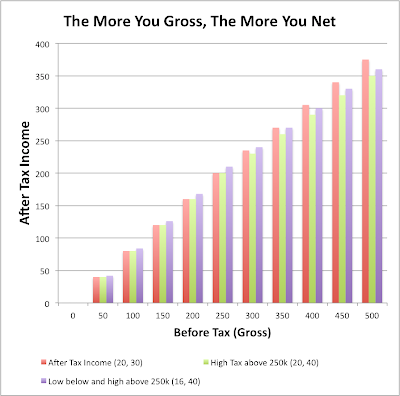
Increase Taxes On The Rich - What that means There is a tremendous amount of innumeracy in this country. I don't know why that is. One thing I keep seeing is talk of tax hikes on those making more that $250k. I want to describe what that means. First, technically, it is an increase of tax rate on incremental (marginal) income above $250k. It's not simply raising the rates on everyone making more than $250k. It may have that effect, but the distinction is important. What is the distinction? Consider a person who makes $1.01 less than $250k. He or she will pay let's say $50k in income tax. If he makes $1 more, he will pay about $0.30 more taxes at a 30% income tax rate. Now let's say that the tax laws change so that income above $250k is taxed at 40% (up from 30%). It does not mean that suddenly his entire income is multiplied by 40%, it means that only the amount above $250k will be multiplied by 40%. So let's say our $249,999 earner gets a raise to $...

Settled Science, Republicans and Democrats

Ezra Klein recently published a blog post in response to a NY Times piece by David Brooks, the conservative on staff there. It was called "T he sad history of climate policy, according to David Brooks." It's interesting on some levels. It shows that the Republicans used their influence to kill initiatives to reduce carbon footprint, forcing the Democrats, who really wanted to do something about carbon into the corner of funding green startups as the only remaining available option. When some of those startups inevitably failed, the Ds became the bad guys on many levels. It is a sad story of the conversion of a bipartisan consensus going away for political gain. Klein makes the point that it is really quite clear who the bad guys are, the Rs. But there is a big assumption behind all this:  Catastrophic  global warming is happening. All the scientists say so. I sent this response to his column: "First, I completely agree with the premise that if Obama is for it, th...

Empty Nesting

We have put our San Ramon home for sale. The kids are out of he house (but still on the payroll). We decided that 2776 square feet of house and 10,000 square feet of yard with a pool is just a bit more than we want to deal with. So we're moving to Oakland. We'll be near Kathleen's work, I'll have a reverse commute, we'll be close to the city, have no yard, and only 1700 square feet to take care of. IT feels good. Here's our house for sale at 51 Sage Circle in San Ramon. Our new place is at Pacific Cannery Lofts . Next stage of life. It's exciting.

Order Things From Amazon

Image
Assassin's Apprentice (The Farseer Trilogy, Book 1)

Plans, Goals, Forecasts, and Estimates

This entry on the Overcoming Bias blog got me thinking. Bosses just want the number . I see a lot of confusion between planning, estimating, goal-setting, and forecasting. Forecasting Forecasting as often used in business is simply giving someone the number that represents business performance. Forecasting accurately is impossible , except maybe in the very short or very long term. Nonetheless, you still at some point need to come up with a number. Forecasting is best done using probabilistic techniques and reporting events as probabilities. Simply predicting a number, even if you are right is of little value in most circumstances. Can you imagine a weather forecaster simply saying, "Rain"? Without a percentage and a timing, it's simply not a real forecast. Estimates Likewise when you estimate business performance, wouldn't it be better to say, given the manpower and marketing budget, there is a 10% chance that we can sell 10,000 units, and a 90% chance that we can se...

Why Paying Off Your Mortgage Early Might Be A Bad Idea

I work with portfolios of real assets. One of the basic concepts of portfolio analysis and management is that you must know what you value. Very seldom does an organization have one single goal that it pursues to the exclusion of all others. It is a useful framework for looking at the mortgage problem that I wrote about earlier. If your single goal in life is to minimize the amount of interest you pay in your life, paying off your mortgage early may be a good strategy. For most people their house loan is the biggest loan they will ever get, typically paying hundreds of thousands of dollars in interest over the life of the loan. These are big numbers, exagerrated by the size of the loan and the time period. However, most people have goals besides minimizing the interest paid. If you take it up to a higher level, most people want to maximize their wealth, which in simple terms is simply money in minus money out. Money in that equation can represent any form of value including house appr...

Do NOT Pay Off Your Mortgage Early

The pay-off-a-little-more-each-month-on-your-mortgage fallacy has been around for a long time. The deal is that the numbers are big, so they are really impressive. Yes. It builds equity faster. (But it's just converting your cash from a flexible form of equity into a less flexible form.) Yes. You pay less interest over time. (But you lose opportunity to invest). Yes, you pay off your house sooner. (How many of us will live in our house for 20+ years though?) There are several ways to look at this prolem though. First, from a strictly financial perspective, the right way to look at this is to consider the alternative uses of the extra money you would be putting into the equity. For example, a 6% loan has an after tax 4% rate. Instead of putting the money into your house, why not put it into a SP500 index fund? It will get you 8% over time (5.33% after taxes). So by putting $1000 into your house, you lose $13.33 each year. Put it into the IRA that you haven't been funding and it ...